Show one clip.
Find every recurrence.
Tourmalign turns match video into football state, learns expert-defined tactical patterns, and retrieves the moments that prove a recurring problem in minutes, not days.
Input
One tactical clip
Retrieval
Similar situations
Output
Coach-ready evidence reel
Mechanism
Recovery press
Possession
Blue · attacking
Output
Searchable situation
01 — The problem
3–5 days.
One tactical question.
Clubs do not need more dashboards. They need better decisions. Today, proving a recurring tactical issue still means manually hunting across matches, notes, tags, and memory.
Coach
Are we conceding this the same way every week?
Analyst
Opens five matches. Scrubs for the pattern. Tags the proof by hand.
Tools
Dashboards show totals. Clip libraries remember tags. Neither remembers tactics.
Outcome
The club answers one question, then starts again next week.
The tactical knowledge of a club lives in analysts' heads and last week's slide deck. The missing layer is memory.
02 — The product
Retrieval for tactical problems,
not another dashboard.
The product begins inside the analyst workflow: a question from the coaching staff, a clip that captures the mechanism, and a system that finds every recurrence across the club's footage.
Wide overload · half-space runner
Coach question: are we conceding this pattern repeatedly?
Match 04
12:44 · same wide overload
Match 07
67:08 · half-space runner
Match 11
24:31 · cutback lane
Wide overload
18 clips
Evidence reel ready
Late runner
11 clips
Evidence reel ready
Rest-defence gap
7 clips
Evidence reel ready
How the workflow moves
- 01Input · tactical moment
Start with the coach question
A real moment from a real match: the goal conceded, the press that broke, the build-up that failed.
- 02Output · ranked situations
Retrieve by football meaning
Tourmalign searches the structure of every match - not file names, event tags, or rough coordinates - and surfaces situations that share the same tactical mechanism.
- 03Output · pattern clusters
Cluster the recurrence
Similar situations group into coach-readable themes: same overload, same runner, same rest-defence gap.
- 04Output · evidence reel
Export the proof
Each cluster becomes a coach-ready evidence reel with overlays - ready for review, opposition prep, or training design.
What it replaces
Manual video review, hand-tagged clip libraries, and tactical knowledge trapped in last week's slide deck.
Who it's for
Head analysts, performance leads, opposition scouts, and coaches preparing for the next match.
Where it sits
Inside the weekly analysis loop - between match review, coach briefing, and training design.
03 — How it works
One system.
Sharper with every match.
Tactical retrieval is the surface. Underneath, the same five stages run for every match. Each stage produces something the next stage learns from - and the design partner loop sharpens all of them together.
- 01
Match video
Broadcast, tactical feed, or training footage
- 02
Football state
Players, ball, shape, possession, phase, context
- 03
Expert labels
Analysts label tactical mechanisms inside the workbench
- 04
Tactical similarity model
Learns when two situations are tactically the same
- 05
Decision output
Retrieval, clusters, evidence reels, diagnosis
Perception
We generate the football state ourselves, on the club’s own match capture.
Expert labels
Analysts teach the system which mechanisms are tactically equivalent.
Usage feedback
Every retrieval, correction, and exported reel teaches the system what tactically similar really means.
04 — World model proof
Expert labels move retrieval.
Two situations can look similar on the pitch and mean very different things tactically. We train Tourmalign on situations analysts have paired by hand — and retrieval starts answering the question the coach actually asked.
Analyst query
Clean win
Before training
Geometry onlyTop result: looks similar on shape, but the analyst said the mechanism is different.
After training
With expert labelsTop result: the situation the analyst paired by hand is now the closest match.
A build-up under pressure. Before training, the model retrieves shape-similar but tactically different windows. After analyst labels, the analyst-graded match moves into the top result.
Analyst query
Rejected look-alike
Before training
Geometry onlyTop result: looks similar on shape, but the analyst said the mechanism is different.
After training
With expert labelsTop result: the situation the analyst paired by hand is now the closest match.
A cross into the box that the analyst marked as a different mechanism. After training, the model rejects the geometric look-alike that fooled the warm baseline.
Where the labels come from
Analysts pair situations the model can learn from.
Every pair is a piece of football knowledge: same mechanism, different mechanism, or a near miss. Each one teaches the model what tactically similar really means.
Build-up own half
Create / finish attack
Recovery press
Create middle
05 — Perception stack
We build the football state the model learns from.
Tracking, pitch view, and aggregation are not the headline. They are how we read the match underneath the product — on the club's own footage, with no new hardware.
Track
Players, identities, and ball - in the broadcast frame.
Players and the ball, tracked across the entire match — built from the broadcast feed the club already records. No new cameras, no install on site.
Project
Broadcast space becomes pitch space.
Every tracked player is placed on a calibrated pitch in real coordinates. The minimap on the right is what Tourmalign actually reads — the structure of the match, not pixels.
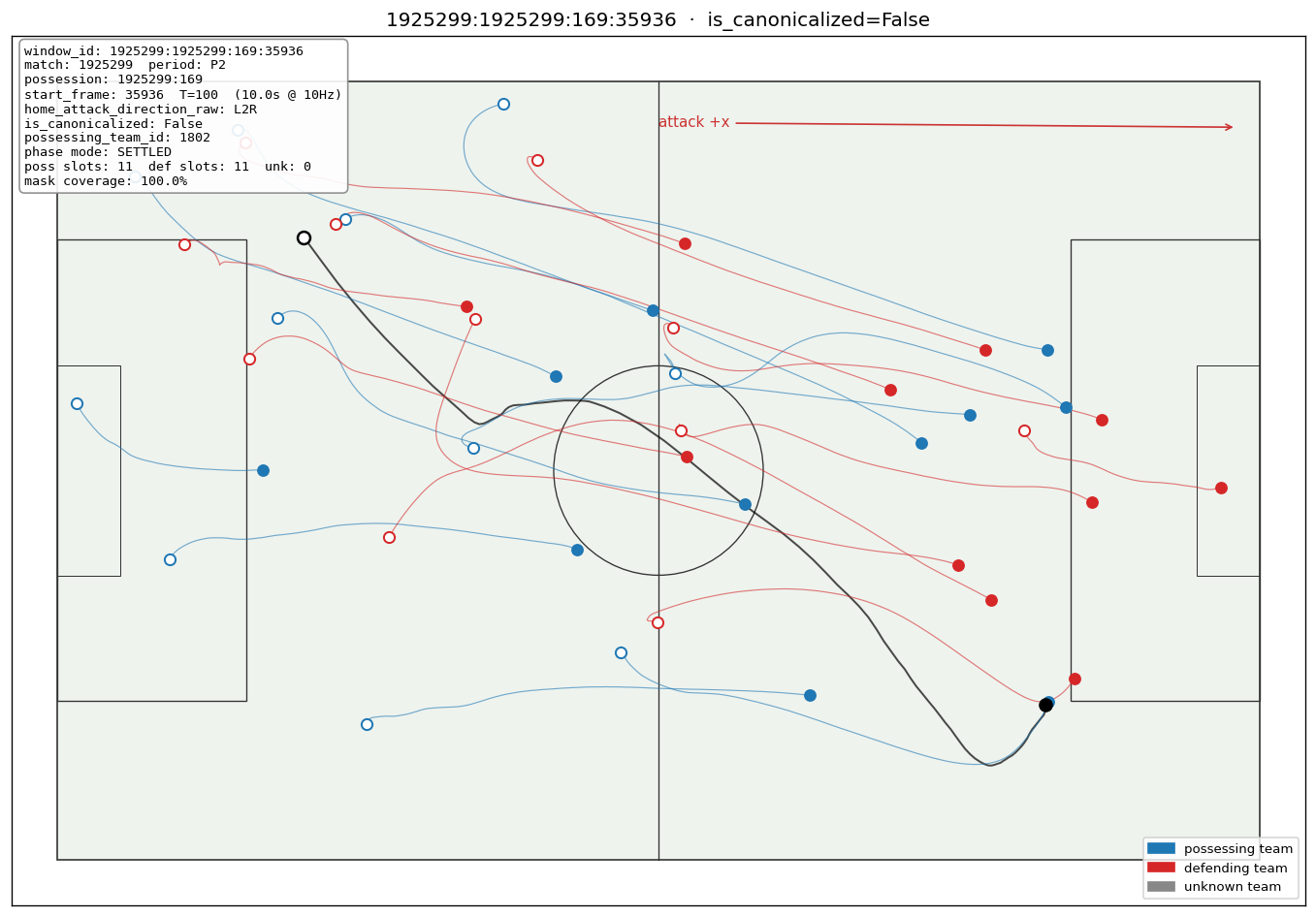
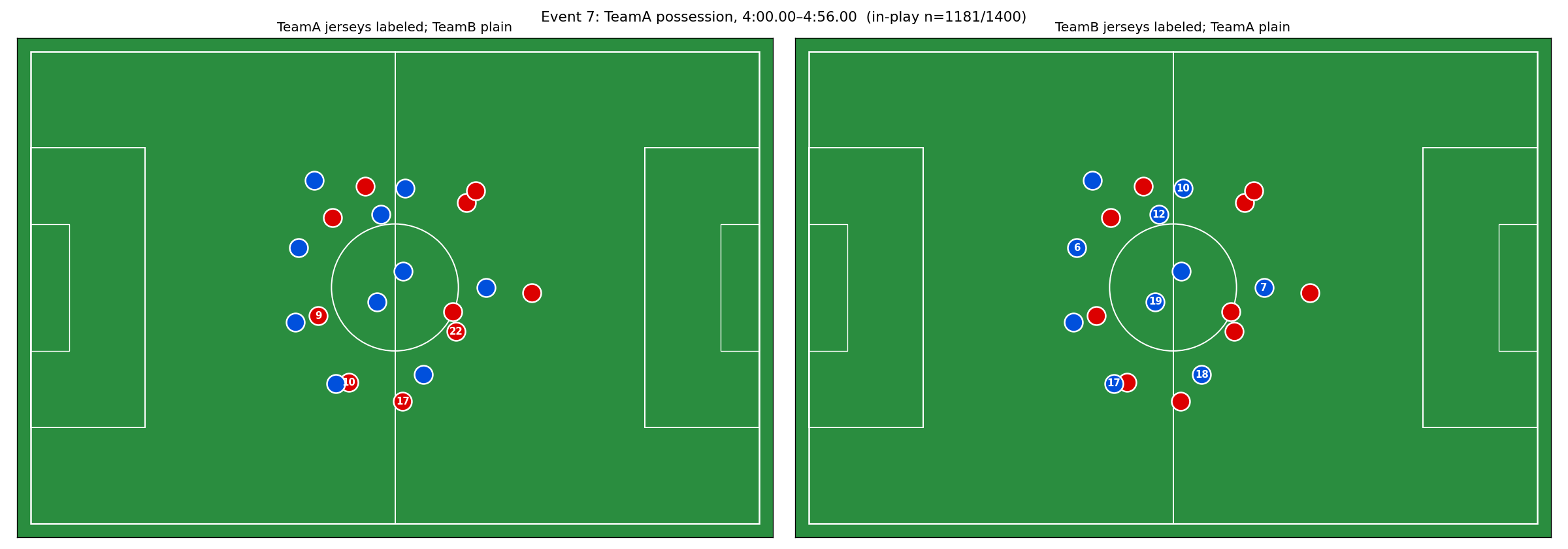

Perception is not the product. It is how the product knows what it is looking at. Owning both is why the system gets sharper with every design partner — instead of plateauing.
06 — Why existing tools don't do this
The product, the world model, and the perception stack all sit on top of the same gap.
Coordinates aren't questions.
Metrics aren't answers.
Existing tools optimise for measurement. Tourmalign optimises for recognition — teaching a model when two situations are tactically the same, even when the opponent, scoreline, and pitch positions are different.
Tracking vendors
Coordinates
They measure shape, but do not learn why situations are equivalent
Event providers
What happened
They tag outcomes, but miss the mechanism before the event
Analytics dashboards
Aggregated metrics
They visualize performance, but do not retrieve the proof clips
Tourmalign
Tactical equivalence
Football state, expert-labelled mechanisms, and analyst feedback in one loop
Tactical equivalence requires three ingredients no incumbent owns together: structured football state, expert-labelled mechanisms, and usage feedback from working analysts. Vertical integration is how we assemble them.
07 — Design partners
How the system actually compounds.
We work with a small group of clubs and academies under a permissioned partnership model. They get tactical retrieval and structured outputs from their own footage. We get the labelled situations and analyst feedback that make the system sharper for every partner that joins next.
Clubs receive
OutputTracking and state outputs
Structured football state from match and training video the club already records.
Tactical retrieval
Find recurring tactical patterns across the season in minutes, not days.
Coach-ready evidence
Clusters, clips, and overlays that move directly into analysis meetings.
Tourmalign receives
InputPermissioned match data
Structured access to club footage and metadata, governed by a clear partnership agreement.
Analyst feedback
Working analysts label mechanisms, rate retrieval quality, and correct misses inside the workbench.
Model-training rights
Explicit rights to learn from labelled situations and improve the system end to end.
More footage
A broader range of phases, formations, opponents, and match contexts.
Better labels
Analysts teach the model which situations are tactically equivalent.
Sharper retrieval
Every partner improves the system the next partner receives.
08 — Trajectory
This starts as retrieval.
It compounds into decision intelligence.
Every step is built on the same asset: football state plus expert-labelled tactical mechanisms. Retrieval is the entry point. The long-term opportunity is the intelligence layer behind football decision-making.
- 01Live
Find similar situations
Tactical retrieval across a club’s match library. This is the first wedge and the product design partners can use immediately.
- 02Building
Diagnose recurring problems
Tie mechanisms to outcomes - chances created, shots conceded, failed presses - so retrieval becomes diagnosis.
- 03Next
Recommend actions
Learn which structural, personnel, or training changes resolved similar situations in the past.
- 04Future
Simulate alternatives
Counterfactual football state — what would have happened if the press had triggered five metres higher.
Clubs & academies
Become a design partner.
We are selecting a small number of clubs and academies with real footage, real analyst workflows, and recurring tactical questions that take too long to answer today.
Match or training footage
A current tactical question
Analyst feedback access
Investors
Request the company brief.
For investor conversations: the short brief covers the market, product wedge, data loop, early retrieval proof, and long-term platform thesis.
09 — Questions